How can the NBA be fix you may ask? Currently the game is in really good place. Its popularity is still growing and people still enjoy the product. In my opinion the way to fix the NBA is to let the players play basketball. No more policing everything little thing they do. Stop telling them what to wear, what to eat and how to act. Just let them be themselves and ease up on the players. Just let them play.
Ever since the inception of the NBA they have been two teams that have dominated the league, the Boston Celtics and the Los Angeles Lakers. Since 1950 a total of 63 NBA finals series have been held. The Celtic/Lakers rivalry has made up a total of 33 champions. The two most celebrated teams have enjoyed major success over the years. This has resulted in 12 meeting between the two. The bad blood has grown over the year and this rivalry has evolved into the biggest rivalry in modern day sport.
Celtic Dominance:
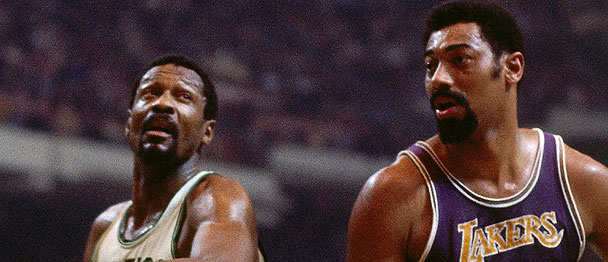
In the early days of the NBA, two players dominated, Wilt Chamberlain and Bill Russell. Each played on a different coast. While Wilt was arguably the better player, essentially breaking every record in the NBA, Bill’s team, the Celtics won 11 championships during his 13 year career. In comparison the Lakers only managed to win one during that period, and were never able to defeat the Celtics.
Wilt and Bill
The 80’s
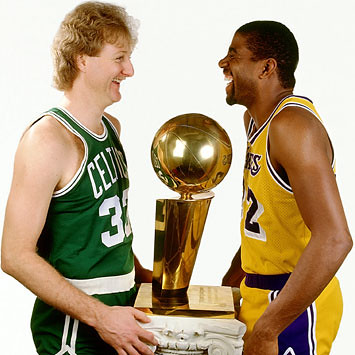
After both clubs were quite during the 70’s, the 80’s proved to be very eventful for both teams. In 1979 the Celtics Drafted Larry Bird while Lakers drafted Magic Johnson in 1980. This led the NBA to once again be dominated by the two most celebrated clubs in its short history. During this period the Lakers were champions 5 times while the Celtics were 3 times. In 1985 and 1987 the Lakers were finally able to defeat the Celtics in the NBA Finals.
Magic and Larry
The 80’s rekindled the rivalry and reignited the bad blood between the two cities. The 90’s were a different story. Both teams had a very lacklustre lineup and were dominated by opponents (namely Michael Jordan.) In the early 2000’s the Lakers acquired superstar centre Shaquille O’Neal and high school phenomenon Kobe Bryant. The Lakers demolished opponents during this period and were able to three peat (2000-2002) and closed the gap between them and the Celtics.
2008-2010 Championships
The rivalry was reignited after the Celtics were able to form a super team in 2008, after acquiring perennial All Stars Kevin Garnett and Ray Allen. Lakers also made some moves and were able to acquire Pau Gasol to complement Kobe Bryant. The two teams faced off in 2008 and resulted in a Celtic victory. Two years later they met again in the 2010 finals. One of the greatest finals series, it went all 7 games. In one of the best games i have ever witness the Lakers rallied from 13 down to win the game and championship, winning back to back championships.
Hands down this is one of the greatest rivalries in modern sports. Enriched with history and great players and moments. Lets hope these two teams are able to bounce back from their recent failures and return to championship quality.
It’s annoying when you start to ponder about the game of basketball in Australia. Sure we’ve had some exports that include Shane Heal, Andrew Gaze and in more recent times, Patty Mills and Andrew Bogut… But they’re really just a few fish in a huge ocean of wasted talent.
If only the NBL could catch fire the way the A-League has done in the last few years, maybe the story would be different. With the youngsters being the real losers in this predicament, there’s never been a true grass-roots element to this particular sport in Australia.
There’s the fallacy of the National Basketball League, NBL, which has been vanishing further and further into oblivion. The clubs have always had to sign B-grade imports from America to fill the empty seats. And in a sad twist of irony, young Australians that hold any glimmer of hope need to make their way over to the states and try their luck in College hoops.
There has to be some form of change, a drastic one, and it has to be now. It shouldn’t be about competing for the kids’ attention and attempting to lure them away from other sporting codes such as Football, they should decide on their own merit. But if the next generation of potential superstars decide to go with the leather Molten ball then they should be provided with all the essentials to facilitate that dream and make it a reality.
In basketball the key or the “paint” is considered a sacred area on the basketball court. While the actual size of the area differs in the many leagues, one thing remains constant: the fact that it is too restricted. The lane basically the easiest way a player can reach the basketball. Historically the bigger would post up in the lane in order to back down smaller and weaker players. This would result in a much higher percentage shot. The NBA was dominated by centers and power forwards. On defense these bigger players would patrol the key and reduce players from scoring easy lay-ups and dunks. However in 2001 the NBA eliminated these players from guarding the paint with critical rule that were introduced.
While the 3-second has existed for offensive players for years, in 2001 the NBA introduced a similar to defensive players. Essentially the rule states “Any defensive player, who is positioned in the 16-foot lane or the area extending 4 feet past the lane end line, must be actively guarding an opponent within three seconds. Actively guarding means being within arm’s length of an offensive player and in a guarding position.” This rule has eliminated the “big man.” Players of the C and PF position now must chase their man where every they go, which essentially opens up the key for guards to waltz in and score at will. While this has encouraged bigger players to develop a jump shot it has also resulted in the NBA turning into a faster game with fewer defensive players. The bigger players are really limited from defending the rim and preventing guards from scoring. It has essentially killed the “big man” in the NBA and it has become a guards game.
NBA players have a love/hate relationship with flopping. Every sporting code has some sort of flopping present within its culture. That being said to the fans it is really something we don’t want to see. The reason we watch sport is to see the best in the world compete on the biggest stage to the best of their abilities. Flopping really diminishes the aspect of fair competition between players. Fans also seem to lose respect for players who flop constantly. In recent times, the Miami Heat, the team who has been champions for the past two seasons, are essentially ridiculed by the NBA community due to the flopping exhibited by their players. LeBron James (who people consider to be the best in the world right now) isn’t exempted from the mocking by the NBA fan base.
With that being said is flopping really an issue to worry about? They NBA seem to think so. During the 2013 playoffs the NBA introduced a foul system in order to combat the amount of flopping in recent times. The system set out to fine players who are determined to have flopped. The violations were:
Violation 1: $5,000 fine
Violation 2: $10,000 fine
Violation 3: $15,000 fine
Violation 4: $30,000 fine
Violation 5: $30,000+ fine and Suspension
While the amounts of the fines were insignificant when compared to the pay of NBA players, the system was really effective. Players were really deterred from flopping and no player committed the violation more than once. It was really a way to name and shame players and no player likes the label of being a flopper. During the first season under the new rules, nineteen players received flopping warnings and five of those were fined $5,000 each for second offenses: Omer Asik, J.J. Barea, Reggie Evans, Kevin Martin and Gerald Wallace. There were no warnings for flopping during the playoffs, and eight players were fined for one violation each: Tony Allen, Chris Bosh, LeBron James, Jeff Pendergraph, J.R. Smith, Lance Stephenson, David West and Fisher. This created more intense NBA playoff series. The Heat’s Conference Final and Finals both went to seven games resulting in a sense of excitement not experienced since the 2010 finals Series.
The debate isn’t over yet. To quote Ken Berger, an NBA insider for CBS sports: “Not everyone agrees. The National Basketball Players Association is seeking an arbitration hearing on the matter after the National Labor Relations Board recently declined to rule on it, and instead recommended that the matter be sent to an arbitrator.” The players union seems to think these rules are unfair. In my honest opinion I think if you are playing at the highest level, you should respect your peers. Flopping really shouldn’t be in the game and with this system the game would be played at a greater level. We will see what is to come of this matter in the upcoming season.
In the summer of 2010 the head of the NBA, Commission David Stern, implemented a new system in policing technical fouls. Essentially technical fouls are in place to filter out any un-sportsman like behaviour on the NBA courts. During the 1990’s this rule was used to eliminate heavy foul play. Everything from elbows and low blows were essentially eliminated from the game, while also retaining its physical and emotional intensity. Players were allowed to display emotion on the court and were even allowed to question the referees rule.
Michael Jordan and Patrick Ewing, two powerhouses during the 90’s
The new ruling in 2010 essentially eliminated emotion from the NBA courts. Players were not allowed to question officials or even show joy or discomfort on the courts anymore. This has led to many problems with players who started their careers in the 90’s. Players such as Rasheed Wallace, Kevin Garrnet and Kobe Bryant have found this system quite hard to adjust to.
If the the first game it was implemented, four technical fouls were called in the span of 16 seconds. Many NBA analysts have question the motives behind the change of rules. The NBA Players Union went further on to discourage the move and put pressure on Stern to change the ruling. “The new unilateral rule changes are an unnecessary and unwarranted overreaction on the league’s behalf,” Hunter said in a statement released Thursday on behalf of the Players Association. “We have not seen any increase in the level of ‘complaining’ to the officials and we believe that players as a whole have demonstrated appropriate behavior toward the officials. Ultimately the rule stands in the current NBA and players are forced to restrain the natural emotion in order to please the organisation.